<?xml version="1.0" encoding="utf-8"?><feed xmlns="http://www.w3.org/2005/Atom" ><generator uri="https://jekyllrb.com/" version="3.10.0">Jekyll</generator><link href="https://www.susanshu.com/feed.xml" rel="self" type="application/atom+xml" /><link href="https://www.susanshu.com/" rel="alternate" type="text/html" /><updated>2026-04-24T23:41:16+00:00</updated><id>https://www.susanshu.com/feed.xml</id><title type="html">Susan Shu Chang</title><subtitle>Productivity, achievement, overcoming failure, and everything in between. Postmortems and how-tos on life, career, and academics.</subtitle><author><name>Susan Shu Chang</name><email>susan@susanshu.com</email></author><entry><title type="html">Slow living - review of 2024</title><link href="https://www.susanshu.com/slow-living-yearly-review-2024" rel="alternate" type="text/html" title="Slow living - review of 2024" /><published>2024-10-12T00:00:00+00:00</published><updated>2024-10-12T00:00:00+00:00</updated><id>https://www.susanshu.com/slow-living-yearly-review-2024</id><content type="html" xml:base="https://www.susanshu.com/slow-living-yearly-review-2024"><![CDATA[<p>As 2024 draws to an end, I’m taking some time to think about what’s happened so far. This year feels fast and slow at the same time; it feels the most relaxed I’ve ever been. Simultaneously, I’ve still accomplished a lot, even if it didn’t feel like that?!</p>

<!--more-->

<h2 id="slow-living">Slow living??</h2>

<p>As of Q4, all I do is work, eat and spend time with family, do things around the home, spend time on my hobbies and with my partner. On weekends and some weeknights I will meet up with my friends and just hang out. I read somewhere that time-boxed “catch-ups” don’t create as much memories as when we were kids and just “play” aimlessly, so I’m trying to go back to college life when we did that a lot.</p>

<p>I’ve also been sitting back and enjoying my book launch - in 2023 I spent the year writing <a href="https://learning.oreilly.com/library/view/machine-learning-interviews/9781098146535/"><em>Machine Learning Interivews</em></a>. It came out digitally end of 2023, but hit the shelves as physical copies in 2024.</p>

<h2 id="conference-chairing">Conference chairing</h2>

<p>This year I tried something new: conference chairing. I sourced speakers and hosted/MC’ed the following conferences:</p>

<ul>
  <li><a href="https://learning.oreilly.com/live-events/ai-superstream-building-with-open-source-generative-ai-models-and-frameworks/0642572001655/0642572001654/">O’Reilly AI Superstream: Building with Open Source Generative AI Models and Frameworks</a></li>
  <li><a href="https://learning.oreilly.com/live-events/ai-superstream-multimodal-generative-ai/0642572005981/0642572005980/">O’Reilly AI Superstream: Multimodal Generative AI</a></li>
  <li><a href="https://qconsf.com/">QCon San Francisco</a></li>
</ul>

<p>Pros: I get to build out my network, as well as learn from industry experts. I’ve gotten to know a lot of the speakers better professionally. This helps me directly as I’ve been working with GenAI and RAG at my work.</p>

<p>Cons: It’s challenging to cold-DM people and not get a response. I found that warm intros were the best. The conferences all have a separate logistics team, so I’m not stuck doing calendar juggling, which was great; I could focus on my strength - my network in the ML/AI community.</p>

<h2 id="conference-speaking">Conference speaking</h2>

<p>I was the ML Keynote at Data Day Texas 2024. I had such a great time there that I immediately said yes when invited back for Data Day Texas 2025.</p>

<p>I was also invited to keynote at another conference, which I will announce when they do. So in total, I did 2 keynotes this year, and chaired/hosted for 3 conferences.</p>

<p>I also did a few talks at other conferences and Meetups, including <a href="https://www.torontomachinelearning.com/">Toronto Machine Learning Summit</a> and the Meetup that I organize, Toronto Women’s Data Group. At this rate I’m getting lazy to update my own speaking page (but I should), as there are just too many!</p>

<h2 id="work">Work</h2>

<p>I don’t share too much about the actual details of work on my personal blog, but I’ve led some exciting work leveraging Generative AI and RAG. Apart from internal demos, I had the chance to speak publicly on some of that work at an Elastic Meetup and Elastic webinar, but the rest will be to come.</p>

<ul>
  <li>Elastic Meetup - Distilling the meaning of language with vector embeddings in Elasticsearch: <a href="https://www.meetup.com/elastic-toronto-user-group/events/298940503">link</a></li>
  <li>Elasticsearch AI Workshop with Microsoft: Craft Generative AI Applications: <a href="https://www.elastic.co/virtual-events/microsoft-ai-workshop">link</a></li>
  <li>IWD webinar (Elastic x Microsoft): <a href="https://www.elastic.co/virtual-events/microsoft-advancing-diversity-ai-development">link</a></li>
</ul>

<h2 id="travel">Travel</h2>

<p>It’s nice to look at where I’ve been, as usual I go to the states a lot for work and personal reasons, and my goal to at least have one non-North America trip has been fulfilled thanks to our company all hands.</p>

<ul>
  <li>Austin, Texas, USA</li>
  <li>Prague, Czechia</li>
  <li>Cottage trip with university friends in Canada</li>
  <li>Boston, MA, USA</li>
  <li>San Francisco, CA, USA</li>
</ul>

<p>I’ve also hosted a few friends from the states in Toronto.</p>

<p>Next year so far I have planned - Austin again, Las Vegas, probably a trip back to Taiwan and dropping by Japan and HK.</p>

<h2 id="personal">Personal</h2>

<p>When it comes to goals that people start to think about at some point: relationships, finance, career, and so on:</p>

<p>I think I’m pretty happy with all of those; I spend a lot of time with family, friends, partner. I’m travelling. I’ve crossed a few major financial goals this year. I go see my family doctor. I’m thriving in my career.</p>

<p>Life is good.</p>]]></content><author><name>Susan Shu Chang</name><email>susan@susanshu.com</email></author><category term="career" /><summary type="html"><![CDATA[Looking back at the year of 2024]]></summary></entry><entry><title type="html">Year in review</title><link href="https://www.susanshu.com/yearly-review-2023" rel="alternate" type="text/html" title="Year in review" /><published>2023-12-20T00:00:00+00:00</published><updated>2023-12-20T00:00:00+00:00</updated><id>https://www.susanshu.com/yearly-review-2023</id><content type="html" xml:base="https://www.susanshu.com/yearly-review-2023"><![CDATA[<p>2023 flew by in a flash. Now that I get some relative peace and quiet… Here’s a quick, not comprehensive recollection of what I was up to this year.</p>

<!--more-->

<h2 id="i-wrote-a-book">I wrote a book!</h2>
<p>It’s my first time writing a full book, <a href="https://amzn.to/3GROYYv"><em>Machine Learning Interviews</em></a>, and it’s published by O’Reilly which has a bunch of amazing reference books and textbooks that I myself learned from in the past. My manuscript had 87,722 words according to Google Docs, but after some editing and proofreading rounds, the exact number might have slightly changed. It took me almost one year exactly from my first words to the printer. It takes a village: there were multiple editors from the publisher side, as well as technical reviewers, and folks that reviewed select chapters (all of which are in the acknowledgements; thank you all).</p>

<p>Overall, I was pretty much exactly on schedule. This was possible because of 1) writing over the years on my blog, so I know how to deal with writer’s block and 2) the story scripts for the video games I’ve released were 70k and 80k words respectively; hardly my first time writing bodies of text in this length.</p>

<p>Overall I’m pretty proud of myself! I barely crunched, and for writing, I’d usually only write up to 2 hours per day, maximum 4 hours a day even when I’m close to the deadline. Slow and steady was my strategy to avoid burning, and to preserve energy for my day job.</p>

<h2 id="i-traveled-to-new-places-and-revisited-familiar-ones">I traveled to new places and revisited familiar ones.</h2>

<p>I went to Berlin (keynote speaker for PyCon DE &amp; PyData Berlin), and explored the rich history there. I went to the US twice: to Orlando and the Bay Area (compared to the past, I stopped going downtown and mostly enjoyed the nature areas thanks to my friend who drives!) I also went to Taiwan for a few weeks to mourn the passing of a close family member with the rest of my family. Those are weeks I will cherish for the rest of my life, and brought me great closure. Apart from cousins, aunts and uncles I hadn’t seen in a while, I also got the chance to catch up with high school and junior high (middle school) friends. I’ve been based in Canada for a long time, but I actually lived in Taiwan for just over a decade!</p>

<h2 id="game-development-went-on-but-without-me">Game development went on, but without me</h2>

<p>Due to prioritizing full time work and the book, I just let the studio’s project managers manage more of the proceedings. On a weekly basis, I spent at most 1-2 hours a week, on some weeks no time at all. This is possible due to established processes and good hires. The studio launched a Kickstarter (which didn’t succeed unfortunately), published a game, and also developed a short game jam (hackathon) game in a month. We had a co-op student who created and released her very own game. A proud moment: “Quill Studios was the perfect placement for me. They equipped me with all the skills I needed to tackle my future aspirations in game design. I’m so thankful to have been able to contribute to their upcoming project and in turn, have a platform to create my own game.”</p>

<h2 id="work">Work</h2>

<p>To not bore people on my personal blog with work, I’ll just briefly touch on some interesting things: used LLMs for a few projects and wrote about one <a href="https://www.elastic.co/security-labs/using-llms-to-summarize-user-sessions">here</a>, <a href="https://www.elastic.co/security-labs/using-llms-and-esre-to-find-similar-user-sessions">here</a> and was <a href="https://www.elastic.co/blog/culture-susan-chang-machine-learning">featured here</a>. I also got great performance reviews and raise/refresher for my performance.</p>

<h2 id="what-the-heck-is-balance">What the heck is balance?</h2>
<p>Apart from the lofty goal of writing a book, I also had goals to spend a certain amount of time with family, my partner, and friends. I’m glad to say that I achieved all of those: seeing friends and family at least once a week consistently, oftentimes more.</p>

<p>I’m not so sure if what I’ve been doing is truly some sort of balance, but rather I kept it as simple as possible (KISS). Apart from earlier arrangements (such as keynote opportunities that were booked months in advance), say no to basically all non-work, professional things apart from the book.</p>

<p>Say yes to social events, but with a rough max upper limit of 3 a week. My friends have plenty of hangouts, so setting a lower minimum wasn’t a problem. Seeing parents frequently has also worked well; I mentally set aside one day of the weekend for them (if I don’t use that day, then it’s an extra day for me).</p>

<p>Note that these are all loose heuristics; if there is something important that happens to happen in the same week, I can make it work. For example, many of my friends’ birthdays are in November, so I went out more than usual. It’s more just that if I said no or yes to everything, then I might end up going out too much or too little, so setting a simple-as-possible bound worked great.</p>

<h2 id="misc">Misc</h2>
<p>Top games:</p>
<ul>
  <li>Divinity: Original Sin 2 (100 ish hours)*</li>
  <li>Stardew Valley (80 hours)*</li>
  <li>Far Cry 5*</li>
  <li>Watch Dogs 2</li>
  <li>Watch Dogs</li>
</ul>

<p>Other games I completed (non-exhaustive): Watch Dogs: Legion, Far Cry: New Dawn, Euro Truck Simulator (ongoing), Forspoken, Kena: Bridge of Spirits, etc. <code class="language-plaintext highlighter-rouge">*</code> noted games were played with my partner.</p>

<p>Top artists listened to on Spotify:</p>
<ul>
  <li>NewJeans</li>
  <li>Weezer</li>
  <li>IVE</li>
  <li>Polyphia</li>
  <li>Kylie Minogue</li>
</ul>

<p>Thanks for reading, and I hope you had a great year too. Also, wishing the best for your 2024!</p>]]></content><author><name>Susan Shu Chang</name><email>susan@susanshu.com</email></author><category term="career" /><summary type="html"><![CDATA[Looking back at the year]]></summary></entry><entry><title type="html">Long term career investment through curiosity</title><link href="https://www.susanshu.com/long-term-career-investment" rel="alternate" type="text/html" title="Long term career investment through curiosity" /><published>2023-07-16T00:00:00+00:00</published><updated>2023-07-16T00:00:00+00:00</updated><id>https://www.susanshu.com/long-term-career-investment</id><content type="html" xml:base="https://www.susanshu.com/long-term-career-investment"><![CDATA[<p>Looking back at some of my proudest moments in my professional life, it’s hard to explain exactly how they came to be. There’s always non-linearity, lots of uncertainty, and chaos. In an attempt to find a common thread and what could be repeatable, it could be that I followed my curiosity and made my own path.</p>

<!--more-->

<h2 id="writing-a-book">Writing a book</h2>

<p>I’m very grateful that I got the opportunity to write a technical book about <a href="https://learning.oreilly.com/library/view/machine-learning-interviews/9781098146535/">machine learning interviews</a>, published by one of the most well known tech publishers, O’Reilly.</p>

<p>What led up to the process though, was many years of writing related hobbies.</p>

<ul>
  <li>I started this blog in 2017. One of my earliest posts: <a href="http://susanshu.com/cfa-level-1-short-time-study-plan"><em>Passing the CFA level 1 exam with 6 weeks of study</em></a>.</li>
  <li>For my <a href="https://store.steampowered.com/curator/5179467-Quill-Game-Studios/">video game studio</a>, I’ve written multiple story scripts, each of 70k+ words.</li>
  <li>Since high school in Taiwan, I’ve been writing long form posts and stories on the internet. Here’s a little piece of internet history for you: <a href="https://en.wikipedia.org/wiki/Wretch_(website)">Wretch blogging platform</a> (RIP)</li>
</ul>

<p>I think that without my long history of consistent writing on this blog and on LinkedIn, I wouldn’t have been selected to be an author, especially in a topic as hot as machine learning interviews.</p>

<p>What informs the content in my book also comes from my free time: I’ve had 80+ coffee chats with folks seeking advice to enter machine learning, or to grow in their careers. I’ve had to wind down this commitment since writing my blog, <a href="https://susanshu.substack.com/">newsletter</a>, and books can reach more people, but teaching online courses on <a href="https://learning.oreilly.com/live-events/machine-learning-interviews-in-3-weeks/0636920080937/">O’Reilly</a> and <a href="https://maven.com/forms/c202d1">Maven</a> where learners can interact directly with me achieves similar goals.</p>

<p>Of course, there’s also the broad range of experience I gained professionally, being principal data scientist in 2 companies, and interviewing 70+ candidates on the other side of the table. Having worked full time in 3 companies, I’ve also interviewed a lot in order to get those 3 job offers (and more), experiencing a wide range of interviews that I’m putting into my book as well.</p>

<p>All of this isn’t easy for others to replicate. To put it bluntly, there’s a lot of career advice being offered by people that haven’t walked the walk.</p>

<p>The summary? It seems like it started with following my interests in writing, <em>without knowing what the payouts would be; and not even expecting a payout…</em> It doesn’t matter whether it’s fiction or non-fiction; there are highly transferable skills with either type of writing.</p>

<h2 id="getting-promoted">Getting promoted</h2>

<p>Recently, I posted a blog post I wrote in 2020, <a href="https://www.susanshu.com/career-open-doors-how-to"><em>Practical thoughts on career door-opening - even without knowing one’s ‘passion in life’</em></a>. I think it’s still relevant now. The gist is that it’s good to do some things that open doors later down the road, even if you’re not sure what to do with those opportunities just yet. Optionality and freedom to choose is the key.</p>

<p>After posting this, a few readers reached out to me with their thoughts. One of them asked me what are good doors to open in the professional world (since the blog post mainly used the analogy of education).</p>

<p>I’d say that the doors I opened that helped me gain more responsibility in my professional life were:</p>

<p><strong>New grad: Differentiating myself and gaining trust in technical skills</strong></p>

<p>I started technical speaking internally at company journal clubs, and at <a href="https://www.youtube.com/c/AISocraticCirclesAISC/videos">Aggregate Intellect’s</a> meetups. The quality and detail of those presentations helped build trust that I could take on more responsibility. That trust in my technical skills helped me land and deliver on large projects that I think aren’t often available to new grads, thus fast-tracking my career many years ahead.</p>

<p><strong>Senior DS: Differentiating myself with more software development depth</strong></p>

<p>The terms “career track”, “career path”, “career ladder” implies one’s career is very linear, but I find it better to conceptualize my career as a boat I’m steering in unknown waters. You could make a stop at an island and look around just out of curiosity, if you’re not afraid of the hassle. You might find bounties on that island that helps you later in the journey.</p>

<p>After my first full time job, I worked on a full-stack developer contract. Due to that experience, I was able to increase my end-to-end ML skills, which was highly valued in a startup environment. I gained responsibility quickly and was trusted with shipping updates to our production ML apps that was serving customers live and adjudicating millions of dollars.</p>

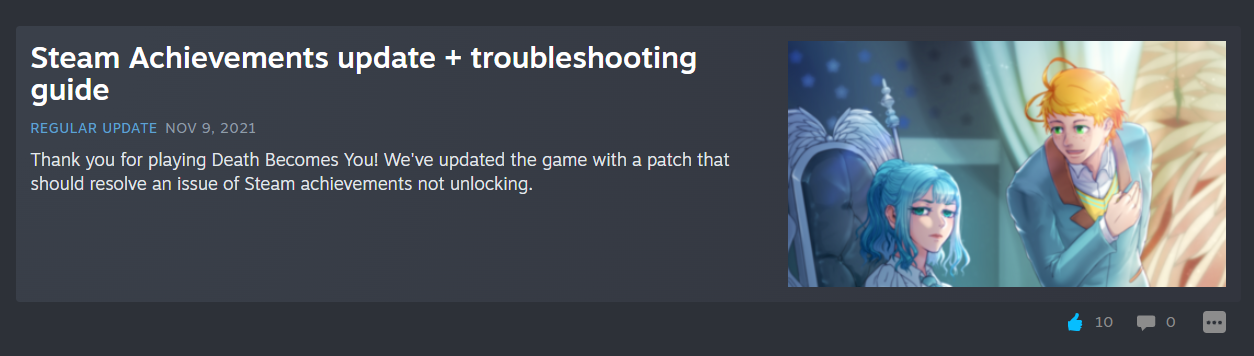
<p>In addition, I continued to gain experience with shipping ML and projects. One surprising thing that helped was game dev (once again, paying dividends). As part of my game studio, I’ve faced tons of common problems and solved them, such as releasing a bugfix on the day of the big launch! A player DMed me on Steam saying my Steam achievements weren’t working. Lo and behold, I had forgotten to include the libraries when building the final distributable files. I sweated, and quickly fixed it. This makes this kind of scenario at my full time job less stressful, since I’ve been there before.</p>

<p><img src="/assets/long-term-career/dby-launch.png" alt="Death Becomes You yuri murder mystery visual novel" />
<em>What a sweaty palms day, fixing a bug on launch as the solo developer.</em></p>

<p><strong>Principal DS: impact at scale</strong></p>

<p>When I was interviewing for principal data scientist roles, a common thread of the job postings was that the candidate demonstrates technical leadership both within and <em>outside</em> their company (on top of required technical skills). I also saw this trend in senior manager roles and above, where “industry influence” was expected. Thanks to my previous experiences in speaking, this was easy for me to demonstrate. Another way I opened doors as a senior DS for this role, was reading how I could impact my team at a larger scale. Here are recommended sources:</p>
<ul>
  <li><a href="https://www.susanshu.com/entry-level-to-senior-developer-multiplier"><em>From entry level to senior+ developer - Multiply impact with developer leverage</em></a></li>
  <li><a href="https://amzn.to/46NZeNg"><em>The Effective Engineer</em> by Edmond Lau</a></li>
  <li><a href="https://staffeng.com/"><em>StaffEng</em> website run by Will Larson</a></li>
  <li><a href="https://amzn.to/3rxY4W4"><em>The Staff Engineer’s Path</em> by Tanya Reilly</a> (This book was published after I had been promoted to a principal DS at a previous workplace, but I’ve read it in order to become better and I highly recommend it.)</li>
</ul>

<p>So, I’d say that public speaking opens doors, on top of the required relevant work experience leading teams, mentoring team members, shipping projects to production, and more.</p>

<p><strong>Stage fright? What do my hobbies have to do with it?</strong></p>

<p>One random thing I hadn’t thought much about was stage fright; I have it, but I know how to deal with it. People will likely deal with stage fright initially once they get started with public speaking; it’s through facing uncomfortable situations that we can gain the skills that aren’t so easily available. Funnily enough, I also had some experience with this through hobbies…</p>

<p>I played electric guitar in high school, and went from not knowing anything to performing in front of 700+ people in a year. There were free lessons provided by my high school club (taught by seniors/senpais), so I learned there. I had a $40 (CAD) cheap guitar and amp, and later borrowed a friend’s uncle’s Ibanez guitar (made in Japan).</p>

<p>In university, I performed a couple of times at the Bombshelter pub, which I recently learned has <a href="https://www.cbc.ca/news/canada/kitchener-waterloo/university-of-waterloo-s-on-campus-pub-the-bombshelter-pub-slated-to-close-1.4953760">closed down</a>… RIP</p>

<p><img src="assets/long-term-career/bombshelter-guitar.jpg" alt="" />
<em>At the Bombshelter Pub. I played guitar and sang backing vocals for a friend.</em></p>

<p>In summary, following my curiosity and interests, help me become a better, well rounded human. This just so happened to help me in my career, which is a thinner slice of me as compared to my whole self as a human. Who’d have thought?</p>

<h2 id="starting-my-ml-career">Starting my ML career</h2>

<p>I studied economics, and didn’t really know what I liked. That changed in my 3rd year where I finally shaped up and stopped failing courses. (I’m not kidding, I’ve failed 2-3 courses, which I retook and passed.) I also got interested in econometrics, which I didn’t know at the time was closely related to machine learning, because it’s pretty much applied statistics for economics.</p>

<p>I also followed my interest in programming to make video games, even if it wasn’t my major. I think university is a great time to start learning things you wouldn’t otherwise have exposure to: many of my friends and professional network have mentioned regretting not taking more electives in university. If that wasn’t possible (looking at you, Waterloo engineering), there’s still a lot of chances to do so while working! Who knows what you could find within yourself.</p>

<p>I’ve written more here on how I entered the ML field:</p>
<ul>
  <li><a href="https://www.susanshu.com/data-science-job-search-1"><em>How I entered the data science field</em></a></li>
  <li><a href="https://www.susanshu.com/build-career-in-data-science-full-journey-story"><em>Build a career in data science</em></a></li>
</ul>

<p>The summary: <em>Following my interests in gaming, which led to programming, despite not majoring in it.</em> Also, shaping my major to focus on what I was interested in, econometrics. Working hard to do well at both the courses that I was interested in, and not interested in but required.</p>

<h2 id="conclusion">Conclusion</h2>

<p>This ended up being a long post. Thank you for reading! If I had to sum up this summary, it’s that taking the road less travelled and gaining broader experiences early on, could unexpected help in leaps and bounds further down the road.</p>

<p>This showed in public speaking helping me gain the same skills to influence product leaders within the company, communicating clearly to my team and cross-functional teams, and more that helped me with delivering big projects and gaining more responsibility. I built solid developer skills through hobby game dev and full-stack dev, which helped me in my career.</p>

<p>I enjoy my hobbies regardless of if they have payout, like video games that cause me to spend money. Just bought an RTX 3080 Ti. Though I think that online multiplayer games are great for working cross-timezone, cross cultures, and wrangling schedules – useful skills! As mentioned in the examples in the articles, it’s not about if you think there will be payoffs, it’s following genuine curiosity regardless.</p>

<p>Overall, I think following your curiosity, and setting aside some time to grow outside of the beaten path, is the common thread. What that means for you, is up to you!</p>]]></content><author><name>Susan Shu Chang</name><email>susan@susanshu.com</email></author><category term="career" /><summary type="html"><![CDATA[Looking back at some milestones in my career so far and how they happened]]></summary></entry><entry><title type="html">The learning curve for long term goals</title><link href="https://www.susanshu.com/long-term-planning" rel="alternate" type="text/html" title="The learning curve for long term goals" /><published>2023-04-09T00:00:00+00:00</published><updated>2023-04-09T00:00:00+00:00</updated><id>https://www.susanshu.com/long-term-planning</id><content type="html" xml:base="https://www.susanshu.com/long-term-planning"><![CDATA[<p>Over the past 2 years or so, (2021, 2022) I had this strange feeling I couldn’t shake off. It was a feeling that my relationship with my personal goals had changed, but not being able to identify what exactly had changed. I didn’t feel the same satisfaction as before from hitting goals, even if my goals had only gotten larger and more complex.</p>

<p>It’s taken a long time to adapt to this feeling, and I still feel that I don’t have an answer. But here are some reflections from my ongoing attempt at understanding.</p>

<!--more-->

<h2 id="why-does-it-feel-like-progress-isnt-as-fast-as-before">Why does it feel like progress isn’t as fast as before?</h2>

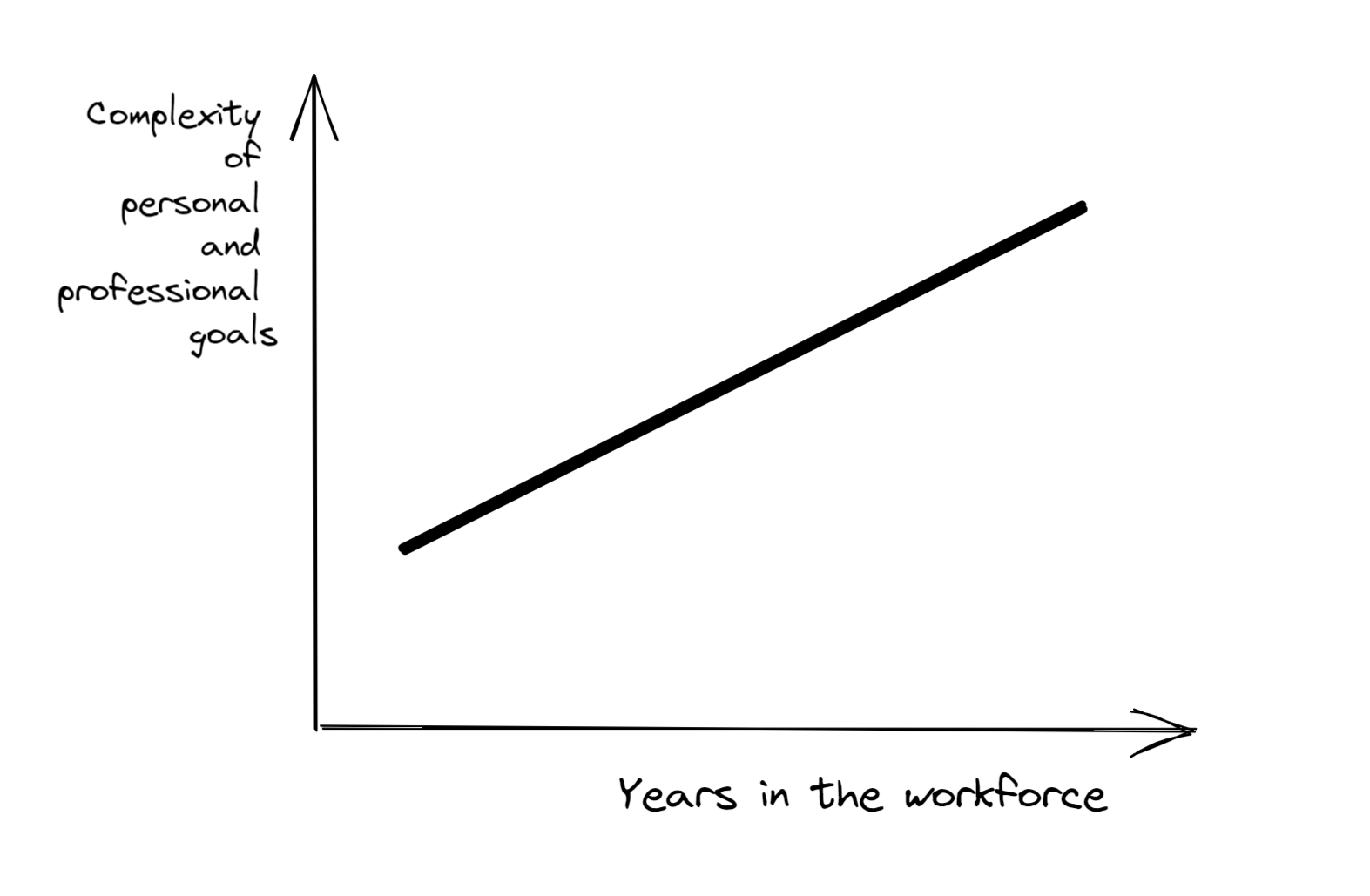
<p>To simplify the situation, my goals when I first started working were relatively simple: start saving, learn as much as possible, and so on. With each year, my goals have gotten more complex and difficult.</p>

<p><img src="/assets/long-term-planning.png" alt="" />
<em>Relationship between my years working and complexity of my goals.</em></p>
<p>Not being aware of this phenomenon led to dissatisfaction: Why’s it taking me so long to do X? How come it’s so difficult to do Y; in the past for a similar goal, I feel that it was easier.</p>

<p>Reflecting on those frustrations led me to understand the following points.</p>

<p><strong>The more I know, the more I know I don’t know</strong>. For a work project, I used to think things were easier when I was entry level. At the time, I focused more on my own responsibilities as an IC (individual contributor). Code my thing, develop my model; now I can check this box off the list. Nowadays, I have to think on a much broader level, about other teams’ goals, and how my team’s work ties into the product and leadership’s goals. Compared to my objectives when I was entry level, things take longer to do due to the broader scope of influence. This broader scope also requires me to work with many more levers that aren’t my main expertise, and have to rely on others’ expertise. This makes me acutely aware of what I don’t know, and that I actually have much much more to learn.</p>

<p><strong>There’s much less instant gratification</strong>. While I was entry level, I could quickly complete tasks. My main objectives were on a daily, weekly, or monthly horizon at most. Now, my main goals are roughly on a monthly or quarterly horizon, with some multi-quarter or multi-year efforts. Of course I do still have some daily to-dos, but completing those barely make a dent towards my main goals, and I feel less satisfied with just checking an item off my to-do list. This is an important thing to adjust to.</p>

<h2 id="1-big-thing-2-medium-things-3-small-things-a-day">1 big thing, 2 medium things, 3 small things a day</h2>

<p>Since my main goals have gotten larger, it’s been less satisfying to do a small coding task these days, or something that’s on a smaller time scale. This leads to dissatisfaction and boredom. How I’ve been making my day to day a bit more exciting is planning what I’m doing with the “123” rule. I think I read about this in blog or book a long time ago, but I can’t quite pinpoint the exact source. (I did find a source that calls it a <a href="https://www.timedoctor.com/blog/1-3-5-rule/">“1-3-5” rule</a>, similar concept.)</p>

<p>I’ll write down the <em>one big thing</em> I should work on today, for example, “outline PyCon slides in the evening”.</p>

<p>Then, I’ll put down 2 medium-length tasks, such as “code review”, “inventorize team tasks and update project board”.</p>

<p>I don’t count any scheduled meetings in this “123” list, since those are tasks that I will do anyway. The “123” list is best suited for things I might procrastinate, and obviously there are more than 6 things to do each day, so not all is captured here.</p>

<p>Lastly, there are 3 small things such as “load dishwasher”, “check insurance payment”, “pick up parcel”.</p>

<p>I like to use this list for personal items more than work items, but frequently include work items anyway. The reason is that at work, there are colleagues that I have to get back to, so I’m much less likely to procrastinate. When I’m not visiting my partner, personal tasks such as checking the mail and loading the dishwasher are easy to just do another day, which causes more headache down the road… (I proactively tidy up more when I’m living with my partner or family.)</p>

<h2 id="dealing-with-the-uncertainty-of-long-term-planning">Dealing with the uncertainty of long term planning</h2>

<p>To tie everything together: many of my objectives these days take months or years of effort to come to fruition. This could lead to boredom or frustration during the day to day, since it’s harder to see how each of my daily efforts are contributing to the bigger picture.</p>

<p>I’m writing about my observations since I suspect other folks might have encountered this type of learning curve when their goals change.</p>

<p>Each week or month I take some time to think about my long term goals again, and see how much I’ve moved the needle. Sometimes, it’s not by much, but knowing that I’m still putting in effort slowly and steadily, gives me confidence that I will eventually achieve the results I want.</p>]]></content><author><name>Susan Shu Chang</name><email>susan@susanshu.com</email></author><category term="career" /><summary type="html"><![CDATA[Adjusting to personal and professional goals that are more complex and difficult.]]></summary></entry><entry><title type="html">Your personal board of directors</title><link href="https://www.susanshu.com/personal-board-of-directors-vs-mentorship" rel="alternate" type="text/html" title="Your personal board of directors" /><published>2023-02-25T00:00:00+00:00</published><updated>2023-02-25T00:00:00+00:00</updated><id>https://www.susanshu.com/personal-board-of-directors-vs-mentorship</id><content type="html" xml:base="https://www.susanshu.com/personal-board-of-directors-vs-mentorship"><![CDATA[<p>My career has benefited a lot from mentorship. I’ve benefited a lot from mentorship. Mentorship often seems mysterious. What is a mentor and how can you get an elusive mentor? How can <em>you</em> mentor someone?</p>

<p>Here’s my experience so that you can see how it could work for you.</p>

<!--more-->

<p>So, the title is about your personal board of directors, which on first glance isn’t about mentorship. But it’s how I personally experience mentorship.</p>

<p>My personal board of directors, career-wise, are people that I know that I can reach out to and get an honest opinion on various things, including:</p>

<ul>
  <li>Advice on career progression, they are happy to share how they got to their positions and answer very detailed follow-up questions for my personal scenario</li>
  <li>Specific perspectives on growth, such as people on the “speaker circuit” and/or tech blog writers</li>
  <li>Second opinion on a job offer, including benefits and comparables</li>
  <li>How the tech stack or organizational design works in their company, or any previous company they’ve worked at before, or companies they happen to know about</li>
  <li>General chit-chat - travel tips, personal life, investing and financial planning</li>
  <li>Sharing their personal knowledge on compensation and salary, sometimes exact figures of their own</li>
  <li>Knowledge on who is hiring (the grapevine)</li>
  <li>The job market / economy</li>
  <li>Resume review</li>
  <li>etc.</li>
</ul>

<p>Note, not all of the people that I consider part of my personal board of directors cover all bullet points, and it is simply not an expectation. For example, some people don’t chat about public speaking, but I can get an honest opinion on the job market and resume review. Some will bounce ideas with me about career progression, but don’t chit-chat. The amount of bullet points they cover has <em>no</em> effect on how I consider them to be a board member.</p>

<p>I’m grateful for every single person that does any point, and together, they cover a lot of bases that it’s unreasonable to expect a <em>singular</em> mentor to do.</p>

<blockquote>
  <p>It’s just unreasonable to expect a single mentor to provide all aspects of mentorship support for your career.</p>
</blockquote>

<p>To use an analogy, it’s like you’re trying to get PC parts to build your dream gaming computer: you need (shortened list for simplification), your CPU, graphics card, memory, storage, tower, etc. Maybe you get the CPU from the Newegg website, some RAM sticks from your local computer store, and GPU from Best Buy because they’re having a sale. You don’t need to get every single thing from Newegg, or every single thing from your local computer store; they might not carry everything you want, or can be out of stock.</p>

<p>Get support for your career in a comprehensive manner, instead of relying on a single source! This also prevents people from burning out.</p>

<h2 id="qa">Q&amp;A</h2>

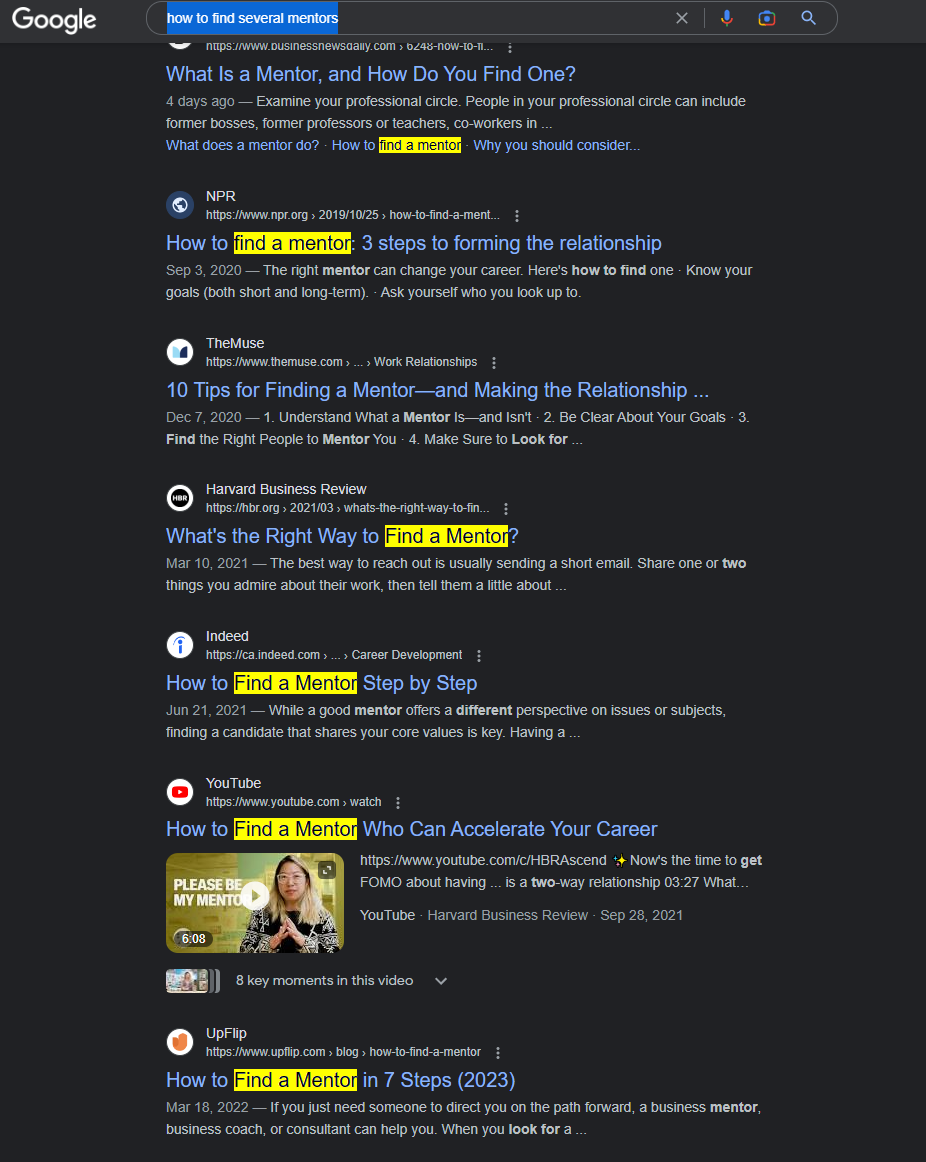
<p><strong>This sounds like having a few mentors, instead of just one.</strong> Yes, that’s correct. I consider many of the people on my personal board to be “mentors”, but some of them might be categorized as a peer; that doesn’t mean I don’t receive mentorship from peers on topics where they have much more experience than I do. I wanted to make the distinction because we often talk about “how to find <em>a</em> mentor”, not “how to find several mentors”.</p>

<p><img style="padding: 15px;" src="../assets/mentor/blog-mentors-highlighted.png" width="400" />
<!-- ![Googling how to find mentors plural shows how to find a mentor singular](../assets/mentor/blog-mentors.png) -->
<em>Googling how to find mentors, plural, shows how to find a mentor, singular.</em></p>
<p><strong>Some bullet points sound like they are friends, such as the chit-chat point.</strong> I consider many people on my personal board of directors my friends as well!</p>

<p><strong>Do they know you call them a personal board of directors?</strong> I don’t really use this term when referring to people in conversation, but to make it more clear for the purpose of this article.</p>

<p><strong>It sounds similar to networking.</strong> Yes, it’s how I met a lot of these people, but I’d say I talk to (most) people on the “board” very consistently; generally once a month, be it over text (most common), call, or in person meeting. That doesn’t have to be a criteria for you though, every few months is enough. One or two folks I consider to be on the “board”, I actually mostly talk to them when either them or I have a big career decision.</p>

<h3 id="whats-the-distribution-of-folks-on-your-susans-personal-board-of-directors">What’s the distribution of folks on your (Susan’s) personal board of directors?</h3>

<p>It’s a wide range: there are multiple industries (at least 5), and with a mix of peers (15% ish) and people I consider more senior to me professionally (85% ish).</p>

<p>The gender mix is about 15% female and 85% male, it just so happens. Note that this doesn’t directly map those individuals to the “peers” vs “more senior” distribution, it’s a coincidence. There are also people I don’t know personally but consider mentors from afar: <a href="https://amzn.to/41pcVPX">Tanya Reilly</a>, <a href="https://charity.wtf/">Charity Majors</a>, <a href="https://lethain.com/">Will Larson</a>, <a href="https://blog.pragmaticengineer.com/">Gergely Orosz</a></p>

<p>They are based across Canada and the US.</p>

<h3 id="how-did-you-meet-the-people-on-your-susans-board-and-why-are-they-willing-to-share-so-much-information-with-you">How did you meet the people on your (Susan’s) board and why are they willing to share so much information with you?</h3>

<ul>
  <li><a href="https://susanshu.com/data-science-community-speaking-get-started">Public speaking</a> and/or <a href="https://susanshu.com/career-networking-definition-explained">attending meetups</a></li>
  <li>Previous coworkers or managers</li>
  <li><a href="https://susanshu.com/regular-writing-practice-benefits">This blog</a></li>
</ul>

<p>The thing is, I never met any single one of these people with the plan that they’d be on my “personal board of directors”. It’s not something I really mentally seek out. I met a lot of these folks while they were also relatively earlier in their career, which made them seem more approachable (?) not that they aren’t approachable now, but I might have been more intimidated, haha. For example someone I met as a <a href="https://staffeng.com/">staff+ IC</a> might be a director or VP currently. We’ve all grown together in our careers for at least 3+ years. The reason they are willing to share so much is trust and consistency, which takes time and commitment from both parties; no shortcut around this.</p>

<p>My advice is that, if you have peers that you often chat about your career with, you can consider them part of your board too. They’re clearly helping you and investing their time into your success, which is what a mentor would do, too. You might have more than you think!</p>

<h3 id="as-a-mentee-what-can-i-offer-to-mentors-or-board-members">As a mentee, what can I offer to mentors or “board members”?</h3>

<p>I think there’s a lot that I bring to the table - mentors that are more senior professionally enjoy asking about the <a href="https://www.kickstarter.com/projects/shiba-visual-novel/autumn-with-the-shiba-inu-hacker-dog-mystery-visual-novel">game development company</a> that <a href="https://susanshu.com/game-development-studio-from-scratch">I’ve built</a>, sharing our tech blog processes (shoutout <a href="https://eugeneyan.com/">Eugene Yan</a> as someone I consider a mentor and board member!), or public speaking opportunities. Even if some of them are prolific speakers, we might share interesting conferences with each other.</p>

<p>So, it could be stuff that we have in common (e.g. writing), or other things that I’ve done, that they might not be interested in doing themselves but are curious about. When they themselves are job seeking, they might ask me to help bounce ideas on their career narrative or their pitch, which I gladly help with.</p>

<p>Something in common with all my mentors is that they <em>never</em> give the impression of condescendingly knowing better than me (I 100% think they know more in many aspects). They all inspire me with how humble they are, and enjoy listening and learning as much as I enjoy listening and learning from them!</p>

<p>I understand that there are some unique things I can bring to the table due to my experiences, but I can also share what early-career folks I mentor bring to the table.</p>

<p>I enjoy hearing about their perspective on the job market, and what things aren’t that intuitive. Being in the industry for a while, it’s really easy to forget the frustration that folks feel during early career job seeking. It’s even more important to me now that I’m writing a book on Machine Learning Interviews, to be published with O’Reilly - gaining that real perspective on what the job market’s like now helps me write better guides and content in the book. Folks can sign up for the <a href="https://www.oreilly.com/live-events/machine-learning-interviews-in-3-weeks/0636920080937/0636920080936/">accompanying O’Reilly course here</a>.</p>

<p>I also enjoy seeing if there are trends in early career job titles, such as how confusing the “data scientist” title has gotten – it can be anything, and differs with every company.</p>

<p>For mentees that are from a different background then me, for example software engineering, I enjoy hearing their perspectives and help them bridge the gap between their knowledge and stats/ML. I could go on, but the point is, if you’re seeking a mentor or someone that will organically become someone that you can turn to for advice, you do have a unique perspective that can be something new in your mentor’s life.</p>

<h2 id="conclusion">Conclusion</h2>

<p>Thanks for reading, and I hope it was helpful! Maybe you already have some people in your network and circle that do these things for you and with you. Maybe someone already considers you a member of their personal board too, whether they use that phrase or not! As always, feel free to share with someone you think would find this useful.</p>]]></content><author><name>Susan Shu Chang</name><email>susan@susanshu.com</email></author><category term="career" /><category term="senior+ DS/MLE" /><summary type="html"><![CDATA[My general response to the question, "How do I get a mentor?"]]></summary></entry><entry><title type="html">Quick guide to customize your resume for different machine learning roles</title><link href="https://www.susanshu.com/machine-learning-roles-tailor-resume-job-search" rel="alternate" type="text/html" title="Quick guide to customize your resume for different machine learning roles" /><published>2022-10-11T00:00:00+00:00</published><updated>2022-10-11T00:00:00+00:00</updated><id>https://www.susanshu.com/machine-learning-roles-tailor-resume-job-search</id><content type="html" xml:base="https://www.susanshu.com/machine-learning-roles-tailor-resume-job-search"><![CDATA[<p>As a job seeker in the machine learning and data science field, the job search process is often confusing from the very start.</p>

<p>Data Scientist, Machine Learning Engineer, Data Analyst, Data Engineer, which one should you apply to?</p>

<p>I had been lost and confused about which roles to apply to during my job search as well. But now, after being in hundreds of machine learning interviews on both sides, I’ve found an effective approach to identify the right machine learning roles most suited for each job seeker to apply to, as well as how to tailor your resume to maximize your chances of getting interviews and offers.</p>

<!--more-->

<p>I’ve refined my approach into 3 steps, and it has helped me land multiple Data Scientist job <em>offers</em> (at various levels), Machine Learning Engineer, and even a senior data science manager role. My goal is to share this process so you can do the same!</p>

<ul id="markdown-toc">
  <li><a href="#machine-learning-roles---what-should-you-pick" id="markdown-toc-machine-learning-roles---what-should-you-pick">Machine learning roles - what should you pick?</a></li>
  <li><a href="#1-take-inventory-of-your-past-experience" id="markdown-toc-1-take-inventory-of-your-past-experience">1. Take inventory of your past experience</a>    <ul>
      <li><a href="#list-out-everything-you-did" id="markdown-toc-list-out-everything-you-did">List out “everything you did”</a></li>
    </ul>
  </li>
  <li><a href="#2-map-your-experience-to-ml-skills-matrix" id="markdown-toc-2-map-your-experience-to-ml-skills-matrix">2. Map your experience to ML skills matrix</a></li>
  <li><a href="#3-tailor-your-resume-to-your-desired-roles" id="markdown-toc-3-tailor-your-resume-to-your-desired-roles">3. Tailor your resume to your desired role(s)</a>    <ul>
      <li><a href="#resume-tailoring-step-by-step-example" id="markdown-toc-resume-tailoring-step-by-step-example">Resume tailoring step by step example</a></li>
      <li><a href="#next-steps" id="markdown-toc-next-steps">Next steps</a></li>
    </ul>
  </li>
  <li><a href="#additional-notes" id="markdown-toc-additional-notes">Additional notes</a></li>
  <li><a href="#conclusion" id="markdown-toc-conclusion">Conclusion</a></li>
</ul>

<h2 id="machine-learning-roles---what-should-you-pick">Machine learning roles - what should you pick?</h2>

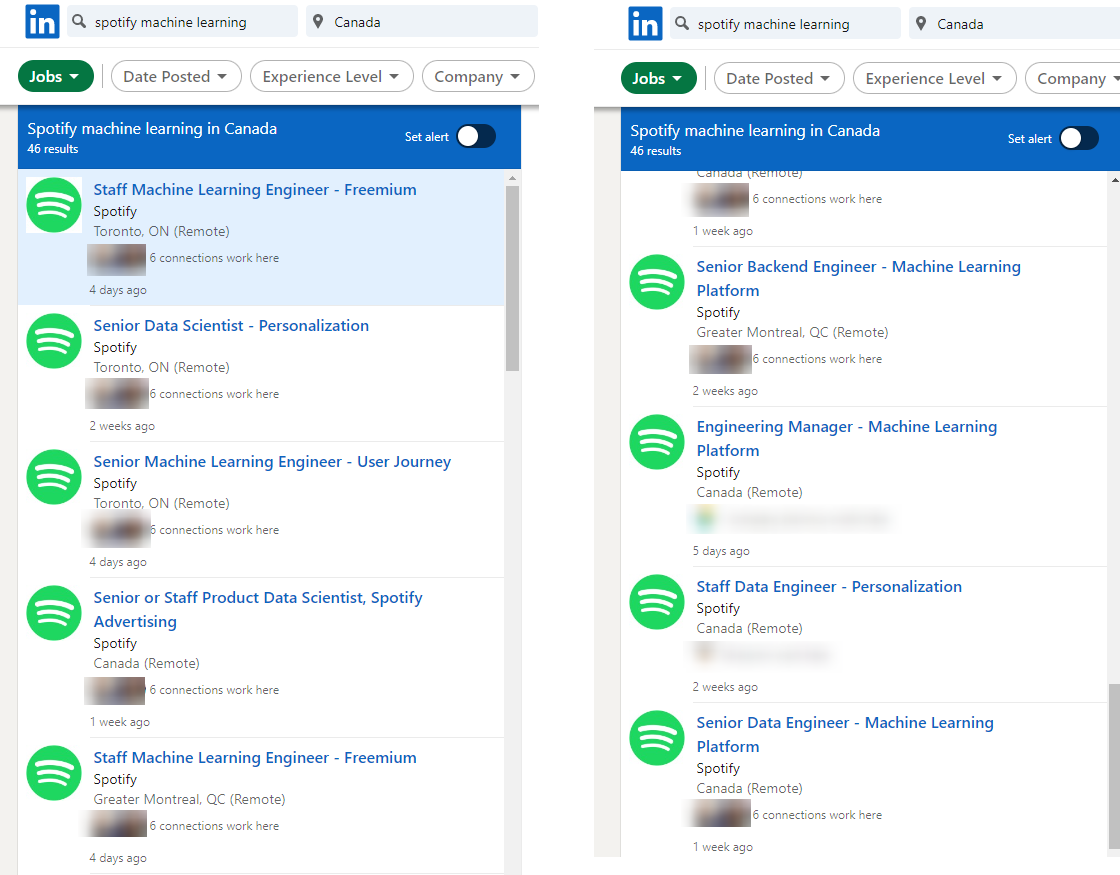
<p>I went on LinkedIn at the time of writing this article and searched “spotify machine learning”.</p>

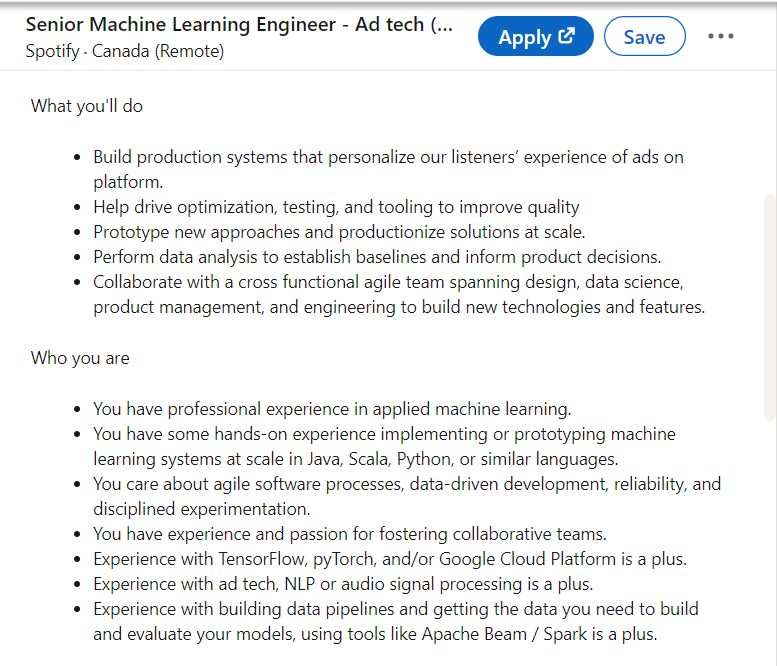
<p>The top results are for Machine Learning Engineer (MLE) and Data Scientist (DS), with those 2 roles showing up evenly in the top 10 results (left side of the screenshot only has the top 5 due to screen space). As I scroll on a bit more, there are backend engineer and data engineer roles as well.</p>

<p><img src="/assets/machine-learning-resume/linkedin-machine-learning-roles.png" alt="machine-learning-roles.png" /></p>

<p>Searching for only “machine learning” yields “data scientist” and “machine learning engineer” being evenly represented in the top 4 results, and then “data engineer”.</p>

<p>How do you find out which job posting best suits your skills, especially if you are a new grad or transitioning careers? My formal education background was in economics, which made it even more confusing for me at the time.</p>

<p>If you’re in the same boat now, I’ve included my own new grad and economics student resume examples - if I could use those projects to enter the machine learning field and build a thriving career, so can you!</p>

<p>Next we’ll walk you through the 3 steps to identify roles for you, and tailor your resume for those roles.</p>

<blockquote>
  <p>I recommend reading all the following steps first to gain a quick overview, and then read a second time slower while following the instructions. Even if you already have a resume, you can see by the end of this article how to best frame it to the roles you’re interested in.</p>

</blockquote>

<h2 id="1-take-inventory-of-your-past-experience">1. Take inventory of your past experience</h2>

<p>Before even applying for a job, we’ll start with taking inventory of what you did in the past.</p>

<p>This inventory includes past work experience, machine learning projects at school or at work - anything that could be relevant to machine learning and data science.</p>

<p>Even if you’ve only had school projects or work experience outside of machine learning, you can still include it - after reading all the steps you’ll learn how to frame it to be relevant.</p>

<p>As an example, when I was a new grad (with under 1 year of working experience), my list looked like this:</p>

<ul>
  <li>(University of Toronto) Econometrics research paper about video game prices on Steam, with data I scraped</li>
  <li>(University of Toronto) Econometrics research paper about Reddit engagement, with data I scraped myself</li>
  <li>(My first full time job) An ML <a href="https://neptune.ai/blog/how-to-implement-customer-churn-prediction">churn model</a> I built</li>
</ul>

<h3 id="list-out-everything-you-did">List out “everything you did”</h3>

<p>From the above list, pick up to 3 of them that you feel that are most relevant to machine learning roles in general. If you feel that you don’t have enough, you can pad with the work or school experiences you had the most responsibilities in.</p>

<p>Next, list out “everything you did” - which is not only technical or coding/ data related parts, but also “soft skills” such as presenting the results to your team or organizing a group chat to coordinate teammates.</p>

<p><strong>New grad (&lt; 1 year experience) example</strong>: My first ML churn model</p>

<ul>
  <li>Exploratory data analysis (EDA) with SQL, Python</li>
  <li>Clean data with SQL</li>
  <li>Train model with SAS</li>
  <li>Run model evaluation and analyze results with SAS, SQL, Python</li>
  <li>Create simplified and cleaner visualization to use in presentation with Excel, PowerPoint</li>
  <li>Present the results with PowerPoint</li>
  <li>Collaborate with ML engineer to put the model in production</li>
</ul>

<p><strong>Economics student example</strong>: Econometrics research paper about Reddit engagement, with data I scraped myself</p>

<ul>
  <li>Scraped Reddit with Python</li>
  <li>Cleaned data with Python</li>
  <li>Statistical modelling with Python, Stata</li>
  <li>Visualized results with Python</li>
  <li>Presented results with LaTeX</li>
</ul>

<h2 id="2-map-your-experience-to-ml-skills-matrix">2. Map your experience to ML skills matrix</h2>

<p>Remember the variety of roles that showed up when searching “machine learning” job postings?</p>

<p>Let’s cut through the noise so you can focus on marketing your skills to the roles that best fit your experience.</p>

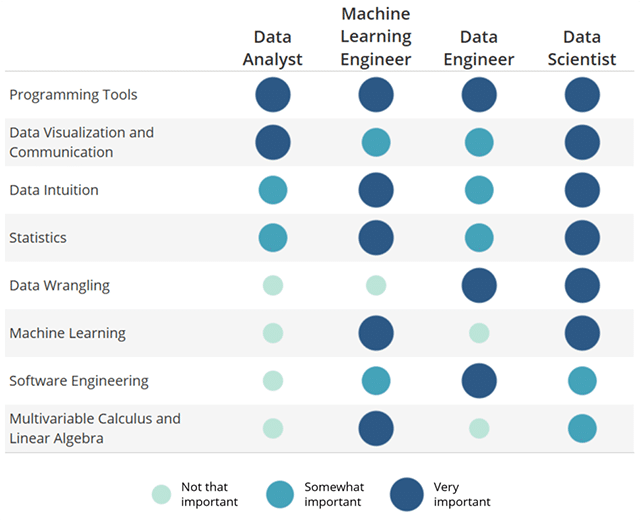
<p>See the table below for a very broad strokes skills breakdown of each role:</p>

<p><img src="/assets/machine-learning-resume/Data-Science-Skills-Udacity-Matrix.png" alt="Data-Science-Skills-Udacity-Matrix.png" />
<em>Source: <a href="https://www.udacity.com/blog/2014/11/data-science-job-skills.html">Udacity</a></em></p>

<p>We can see right off the bat that Data Analyst can have an overlap with Data Scientist, which in turn overlaps a lot with MLE. The good news is that with a few of these skills in the skills list, you can apply to one or <em>more</em> of the roles.</p>

<p>But don’t worry - for entry level roles, as long as we have one or two of these skills, we’re good to go for applying to jobs. It’s also perfectly normal for new grads to have strong skills in one particular aspect but not all aspects, which employers fully understand and welcome.</p>

<p>However, mapping your skills to this matrix is only part of this entire process, because the reality is, this matrix has to be taken with a heavy dose of “<strong><em>it depends</em></strong>”. That’s why for the 3rd step, we’re ready to look at real job postings to apply to.</p>

<h2 id="3-tailor-your-resume-to-your-desired-roles">3. Tailor your resume to your desired role(s)</h2>

<p>Alright, now we’re back to the job postings search engine of your choice! I personally like to start with LinkedIn, since I’m familiar with the platform, but most job are cross posted on major platforms anyway.</p>

<p>Based on the skills matrix, you can already see why tailoring your resume can be useful - if you have “programming tools” and “statistics” skills, you can possibly apply to DS and MLE, but in order to highlight additional skills that differ between the two roles, changing some bullet points would help market your skills better.</p>

<p>Remember how I said that for the ML skills matrix, “it depends”? It helps you narrow down titles that fit your past experience better, but you should still look into the jobs descriptions themselves.</p>

<p>Once you start to look at job posting descriptions, sometimes “Data Scientist” might involve skills that were mapped to data analyst (“Product” data science), and sometimes the job posting could map more to MLE on the matrix.</p>

<p>My personal experience of “<strong><em>it depends</em></strong>”: My job title has been Data Scientist for all of my full time roles, but I’ve always been focused on building and deploying machine learning models into a product, or improving the ML product. Based on the matrix, I’ve done everything from MLE, “Applied scientist”, and more.</p>

<h3 id="resume-tailoring-step-by-step-example">Resume tailoring step by step example</h3>

<p>You’re reading this article, but I’ll try to make it like a screensharing experience as if I’m browsing these jobs and you’re looking over my shoulder.</p>

<p>Now, I’m back to browsing the “spotify machine learning” search result from the beginning of this article, and start clicking into them.</p>

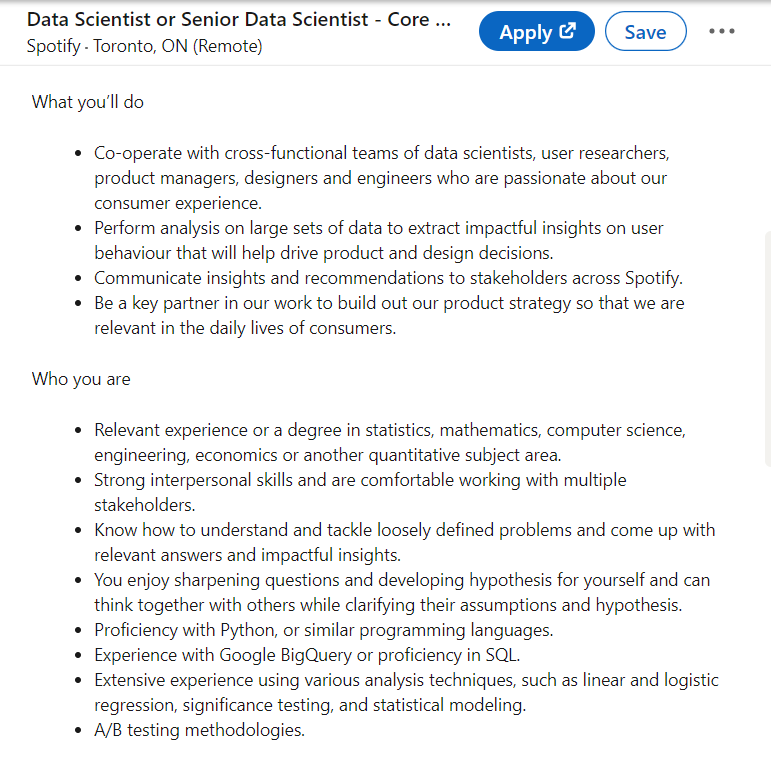
<p><strong>Example 1: Data Scientist posting</strong></p>

<p><img src="/assets/machine-learning-resume/spotify-ds.png" alt="Spotify data scientist job posting LinkedIn" /></p>

<p>I read this Data Scientist posting, and write down what I think is important in it:</p>

<ol>
  <li>Cooperation with stakeholders, communication (mentioned multiple times and are at the top of the bullet points)</li>
  <li>Perform data analysis, using BigQuery or SQL</li>
  <li>Some statistical modelling such as linear, logistic regression</li>
</ol>

<p>Next, I’ll look back to the list of 7 points from “My first ML churn model!” example in Step 1, and map it to the Data Scientist posting.</p>

<p>The most relevant points are:</p>

<ul>
  <li>Exploratory data analysis (EDA) with SQL, Python</li>
  <li>Create simplified and cleaner visualization to use in presentation with Excel, PowerPoint</li>
  <li>Present the results with PowerPoint</li>
</ul>

<p>I’ll tailor my resume for this Data Scientist role focused on these points, and shorten <em>or remove</em> the other parts, so that it’s focused on those 3 bullet points instead of 7.</p>

<p>How much you’d remove depends on how much space you have on your resume! I have more experience now so I err on the side of removing, while early on I chose to pad more points.</p>

<p>It’s fine to remove things as long as the core is there; if the interviewers were interested in how I train more complex ML models - a bullet point I removed since it wasn’t on the job description, they can just ask me in the interview.</p>

<p>I’d then summarize those 3 points into even less bullet points, while keeping the information, such as “Churn predictive modelling to optimize campaign targeting for customer retention, and explainability analysis for stakeholders to understand the model interpretation [SAS language, Python, SQL]”.</p>

<p><strong>Example 2: Machine learning engineer job posting</strong></p>

<p><img src="/assets/machine-learning-resume/spotify-mle.png" alt="Spotify data scientist job posting LinkedIn" /></p>

<p>Now, I read this Machine Learning Engineer (MLE) posting, and write down what I think is important in it:</p>

<ol>
  <li>Implementing ML in production</li>
  <li>Prototyping</li>
  <li>Testing and tooling, platform improvements</li>
  <li>Collaboration with cross functional teams</li>
</ol>

<p>Next, I’ll look back to the list of 7 points from “My first ML churn model!” example in Step 1, and map it to the MLE posting.</p>

<p>The most relevant points are:</p>

<ul>
  <li>Train model with SAS</li>
  <li>Run model evaluation and analyze results with SAS, SQL, Python</li>
  <li>Collaborate with ML engineer to put the model in production</li>
  <li>Clean data with SQL</li>
</ul>

<p>With the same experience, for different job requirements, I now have different bullet points that were grabbed from the same skills inventory I did in Step 1. For job-seekers that are looking for their very first MLE role, I also recommend reading <a href="https://capitaloneshopping.com/p/designing-machine-learning-syste/2PV5TDSH8S">this book</a>, “Designing Machine Learning Systems” by Chip Huyen (I own a physical copy) to get a sense of the skills that are needed for the MLE role.</p>

<p>The best part is, the inventory from Step 1 can simply be reused for different types of roles without needing to re-write anything.</p>

<p>As an aside: Communication and collaboration skills are important, and you’ll notice them listed a lot in all types of job postings. Don’t forget to include the points where you were collaborating with other teams, or presenting your work to another organization in at least one of your resume points.</p>

<p>This is especially relevant for folks that think they don’t have enough “ML experience”! Your experience analyzing data, as well as <em>communicating</em> it, is important and can strengthen your resume more than you might think.</p>

<h3 id="next-steps">Next steps</h3>
<p>Now, you’ve learned how to identify the machine learning roles best suited for you, and you’re ready to create a set of tailored resumes for each type of role.</p>

<p>Now, you might be thinking - it’s too much work to tailor for every single job posting there is! To which I agree, and here’s how I optimize the use of tailored resumes:</p>
<ul>
  <li>I look at more job postings, find what suits me and interests me the most, and note down what they have in common. The types of “Data Scientist” roles I’m interested in could be very different from “Data Scientist” roles that interests another job seeker.</li>
  <li>I try to create 2-3 tailored resumes that I can send out en masse to roles that need similar skills, such as to DS or MLE that requires more MLOps knowledge, and another that is more analytics focused.</li>
  <li>For jobs I’m very very interested in, I build off those tailored resumes and fine-tune them for each job post. This is not a waste of my time and has yielded a very high call-back rate for me.</li>
</ul>

<h2 id="additional-notes">Additional notes</h2>

<h3 class="no_toc" id="the-power-of-resume-customization">The power of resume customization</h3>

<p>By the time I graduated from my economics master’s program, I had a job offer as a Data Scientist, and at the same time, a job offer for PM at Ubisoft - two very different types of roles, in very different industries. <em>With the same student project experiences, just written and framed differently in my tailored resumes.</em></p>

<h3 class="no_toc" id="make-your-own-experience">Make your own experience</h3>

<p>When I was a new grad, I lacked ML “deployment” experience, but I saw it on many job postings, so I wanted that on my resume. After serving a machine learning model in a web app in my own <em>side project</em>, I put it on my resume and voila, I was getting multiple interviews for senior roles (one even flew me from Toronto to San Francisco).</p>

<p>I’ve written about how to pick a data science project that stands out on your resume <a href="https://www.susanshu.com/data-science-side-project">in this article</a>.</p>

<h2 id="conclusion">Conclusion</h2>

<p>In this article we looked at different types of machine learning roles, how to take inventory of your past experiences, and then tailor the way you present your resume based on those job postings.</p>

<p>This creates a powerful career story that is much more effective than sending the same resume for all machine learning roles. While this helps especially for new grads and for career transitions, it can be helpful for current data professionals looking to specialize or move to a different role.</p>

<p>I hope that you’ve found any point helpful, and if you know anyone that would benefit from this, please share it with them! If you’d like to ask more questions that I can elaborate on in a future article, feel free to reach me at hello@susanshu.com or message me on LinkedIn.</p>]]></content><author><name>Susan Shu Chang</name><email>susan@susanshu.com</email></author><category term="data science" /><summary type="html"><![CDATA[Tailor your resume effectively and find the machine learning role that matches you the best.]]></summary></entry><entry><title type="html">How I triage Slack messages</title><link href="https://www.susanshu.com/slack-channel-triage" rel="alternate" type="text/html" title="How I triage Slack messages" /><published>2022-07-23T00:00:00+00:00</published><updated>2022-07-23T00:00:00+00:00</updated><id>https://www.susanshu.com/slack-channel-triage</id><content type="html" xml:base="https://www.susanshu.com/slack-channel-triage"><![CDATA[<p>If you use Slack at work, you probably know the following struggle: There are <em>so many</em> channels and messages to catch up on, but which ones are <em>actually</em> important? In addition, scrolling up and down and up and down to find channels can be overwhelming.</p>

<p><img src="/assets/slack-triage/blog-slack-triage-thumb.png" alt="" /></p>

<p>Here’s what I do to organize my channels and make sure my messages are triaged properly. The principles can be applied to other work chat apps as well.</p>

<!--more-->

<ul id="markdown-toc">
  <li><a href="#triage-slack-messages-by-creating-tiers-for-channels-and-messages" id="markdown-toc-triage-slack-messages-by-creating-tiers-for-channels-and-messages">Triage Slack messages by creating tiers for channels and messages</a></li>
  <li><a href="#update-priority-chats-based-on-immediate-project" id="markdown-toc-update-priority-chats-based-on-immediate-project">Update priority chats based on immediate project</a></li>
  <li><a href="#additional-tips" id="markdown-toc-additional-tips">Additional tips</a></li>
</ul>

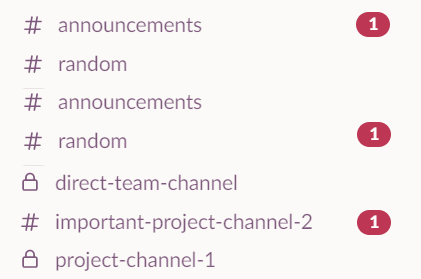
<p>Let’s start at the beginning. By default, the channels are sorted alphabetically, which causes the following:</p>
<ul>
  <li>I need to remember the channel name if I’m trying to find a relevant channel</li>
  <li>Otherwise, I can scroll up and down and up and down</li>
  <li>I can use the search bar to try to find the channel (an extra step)</li>
</ul>

<p><img src="/assets/slack-triage/blog-slack-triage-4.png" alt="" /></p>

<p>The above points have increasingly become distracting, since orgs, whether large or small, have many many channels. We can actively try to leave the channels that are no longer relevant, but that requires a lot of energy. In fact, with the method in this post it’s totally fine to hoard channels. Join as many as you like and still respond quickly to relevant ones!</p>

<h2 id="triage-slack-messages-by-creating-tiers-for-channels-and-messages">Triage Slack messages by creating tiers for channels and messages</h2>

<p>I love using the “<a href="https://slack.com/help/articles/360043207674-Organize-your-sidebar-with-custom-sections">custom section</a>” feature on Slack (paid). If this is for work, chances are it’s on a paid plan.</p>

<p><img src="/assets/slack-triage/custom-sections.en-US@2x.gif" alt="" />
<em>Source: <a href="https://slack.com/help/articles/360043207674-Organize-your-sidebar-with-custom-sections">Slack</a></em></p>

<p>I start with 3 tiers:</p>
<ul>
  <li>Top priority</li>
  <li>Mid priority</li>
  <li>Low priority (unsorted, unorganized)</li>
</ul>

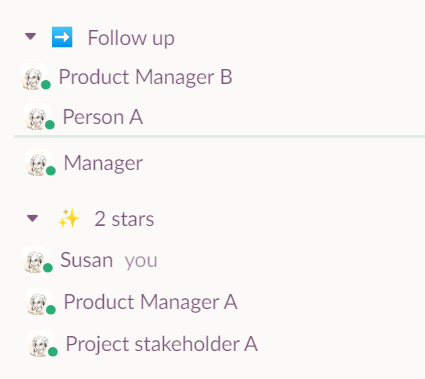
<p>However, I’ve found that it’s best to add a “follow up” section between top priority and mid priority. This is for chats that could be time sensitive, or for after meetings you say you’ll follow up. It’s very easy to forget.</p>

<p>Here’s a further breakdown of how I’d sort these:</p>

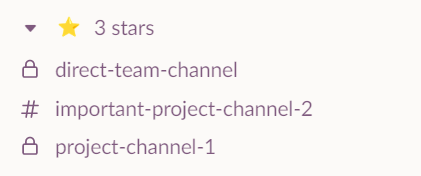
<h3 class="no_toc" id="top-priority-3-stars">Top priority (3 stars)</h3>

<p>The channels I tend to put in this category are:</p>
<ul>
  <li>The channel with my direct team, or direct project(s)</li>
  <li>The people I work most closely with
    <ul>
      <li>I change this now and then based on the project</li>
    </ul>
  </li>
  <li>Sometimes, my manager</li>
</ul>

<p><img src="/assets/slack-triage/blog-slack-triage-3-1.png" alt="" /></p>

<h3 class="no_toc" id="follow-up">Follow up</h3>

<ul>
  <li>People I said I’d get back to. I move them out of this section after I respond, to not clog up the section.</li>
  <li>Some un-urgent (but still important) longer back and forths, such as asking HR about a benefits plan set-up which takes longer to fully go through.</li>
</ul>

<p><img src="/assets/slack-triage/blog-slack-triage-3-2.png" alt="" /></p>

<h3 class="no_toc" id="mid-priority-2-stars">Mid priority (2 stars)</h3>

<ul>
  <li>People in my direct project. For example, when I’m working on project A, I’d put engineer A and product manager A who are also on that project, here</li>
  <li>Other direct teammates, such as data scientists</li>
  <li>Anything else that I feel I should keep an eye on, but I try to not clog this section too</li>
</ul>

<p>Sometimes, I have a section for select (but not 3-star) group channels here, for watercooler chat needs.</p>
<ul>
  <li>The <em>pets</em> channel is often placed here.</li>
</ul>

<h3 class="no_toc" id="the-rest-unsorted">The rest (unsorted)</h3>

<p>For anything else, I leave them in the original “Channels” and “Direct messages” sections.</p>

<p>This way those channels are in the bottom, and I can easily hide them by collapsing the section. It keeps things clean.</p>

<h2 id="update-priority-chats-based-on-immediate-project">Update priority chats based on immediate project</h2>

<p>I rearrange the channels and direct messages in my priority sections.</p>

<p>For example, if I move from project A to project B, I’ll move up the new people I deal with frequently in project B upward to the top tiers, and move down project A team members (unless there’s some other reason their chats are prioritized.) This way it doesn’t clog up the top tier sections.</p>

<h2 id="additional-tips">Additional tips</h2>

<p>1) Use the <a href="https://slack.com/help/articles/204411433-Mute-channels-and-direct-messages">mute functionality</a> as needed.</p>

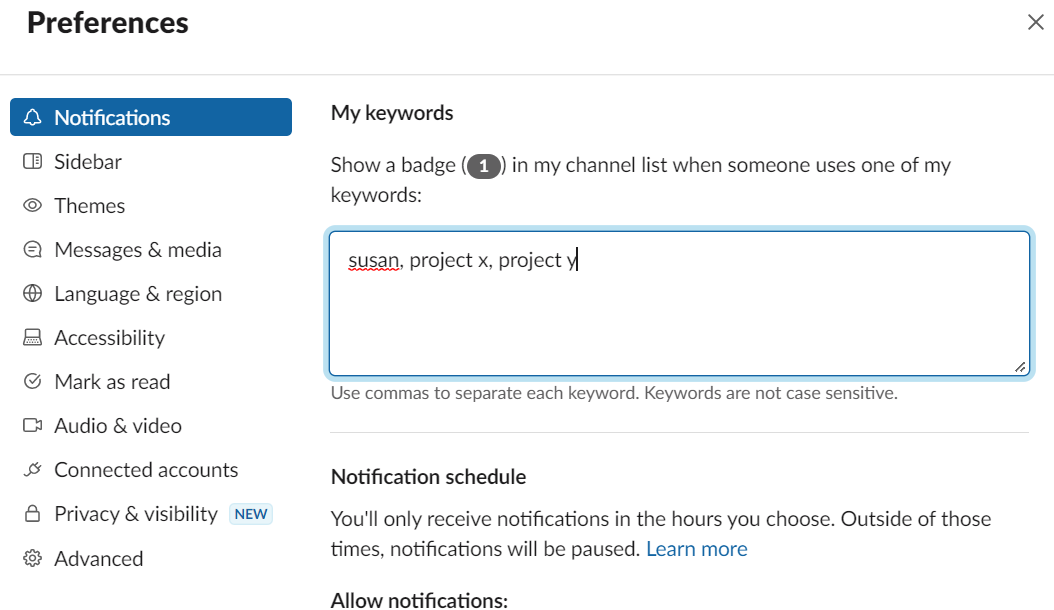
<p>2) I use notification keywords to further prioritize messages since I don’t want to scan general-purpose channels for chats relevant to my projects. (Preferences - Notifications)</p>

<p><img src="/assets/slack-triage/notification-keyword.png" alt="" />
<em>I’ll get notified when there’s a mention of “project x” and “project y”.</em></p>
<p>3) I personally immediately turn off desktop notifications. To me, they distract my flow and also are bad when screensharing. Depending on your job role, you can evaluate this for your own needs.</p>

<h2 class="no_toc" id="conclusion">Conclusion</h2>

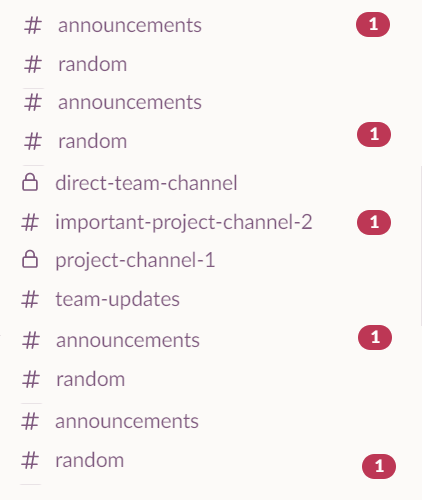
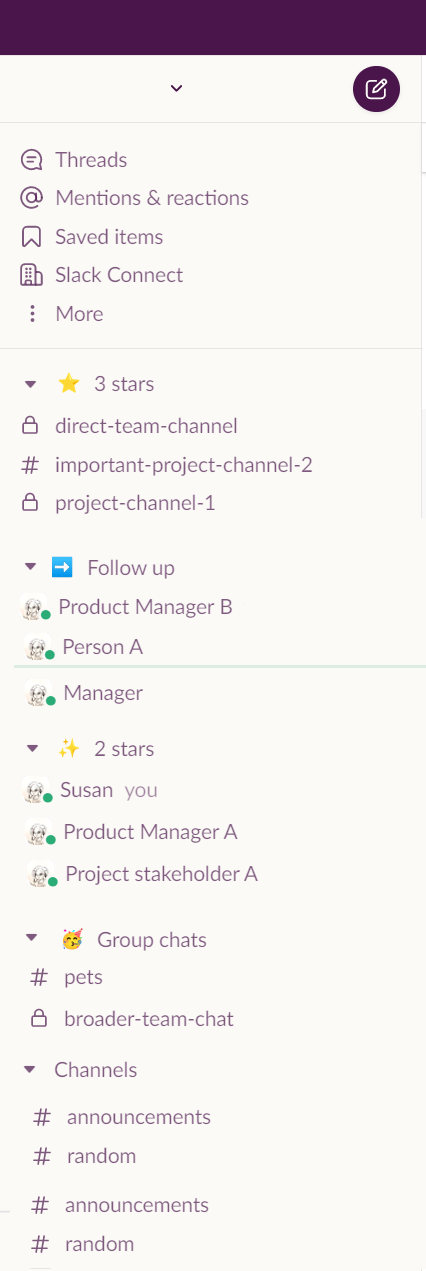
<p>The end result looks something like this (mock screenshot):</p>

<p><img src="/assets/slack-triage/blog-slack-triage-3.png" alt="" /></p>

<p>At a glance, if I have a DM or ping in the top priority channels, I know that there’s high justification to respond to those quicker than other channels. Of course, other rules apply such as not checking Slack when I’m heads down focused, which is a separate discussion.</p>

<p>I can still hoard channels and they’ll be at the bottom - if there are pings they don’t distract me much from the immediate project information at hand.</p>

<p>I’d be happy to hear your thoughts on this as well <a href="https://www.linkedin.com/feed/update/urn:li:share:6956647099912384512">via LinkedIn</a>.</p>]]></content><author><name>Susan Shu Chang</name><email>susan@susanshu.com</email></author><category term="productivity" /><summary type="html"><![CDATA[How to organize Slack messages so that most important ones are seen at a glance, and that joining many channels doesn't become overwhelming.]]></summary></entry><entry><title type="html">The Data Scientist Show - Reinforcement Learning, Productivity, and more (Podcast)</title><link href="https://www.susanshu.com/data-scientist-podcast-susan-shu-chang-reinforcement-learning" rel="alternate" type="text/html" title="The Data Scientist Show - Reinforcement Learning, Productivity, and more (Podcast)" /><published>2022-06-30T00:00:00+00:00</published><updated>2022-06-30T00:00:00+00:00</updated><id>https://www.susanshu.com/data-scientist-podcast-susan-shu-chang-reinforcement-learning</id><content type="html" xml:base="https://www.susanshu.com/data-scientist-podcast-susan-shu-chang-reinforcement-learning"><![CDATA[<p>It was really fun to be on Daliana Liu’s podcast, “The Data Scientist Show”! Big thank-you to her for having me on the show.</p>

<p>Listen or watch in the link below.</p>

<!--more-->

<div class="youtube-wrapper">
    <iframe src="https://www.youtube.com/embed/xlp9A6xdxoo" frameborder="0" allow="accelerometer;" allowfullscreen="true"></iframe>
</div>

<h3 id="useful-timestamps">Useful timestamps</h3>

<ul>
  <li>0:00 Intro</li>
  <li>00:01:29 how Susan changed from economics to econometrics and finally to data science</li>
  <li>00:07:23 what reinforcement learning is doing</li>
  <li>00:15:58 how to find the right rewards</li>
  <li>00:20:00 recent reinforcement learning use cases</li>
  <li>00:27:28 how to add reinforcement learning to social media recommender system</li>
  <li>00:44:42 how to assess cannibalization effect</li>
  <li>00:48:24 how to tell if people use the model you build</li>
  <li>01:04:42 common mistakes people make when putting models in production</li>
  <li>01:08:30 Susan’s day-to-day as a principal data scientist</li>
  <li>01:14:05 what productivity really means</li>
  <li>01:21:04 a few things she wanted the listeners to know about productivity</li>
  <li>01:41:48 books and blogs she recommended about productivity</li>
</ul>

<p>It’s also available on <a href="https://open.spotify.com/episode/7IWAOVIE3Gg96kRPVvaTMz?si=020be7fee76c4618">Spotify</a> and <a href="https://podcasts.apple.com/us/podcast/reinforcement-learning-common-use-cases-recommendation/id1584430381?i=1000565587213">Apple Podcasts</a>. Definitely go explore other awesome talks there as well!</p>

<p>I’ve been working on updating my <a href="/speaking">talk appearances page</a>, if you want to check out more talks.</p>]]></content><author><name>Susan Shu Chang</name><email>susan@susanshu.com</email></author><category term="data science" /><summary type="html"><![CDATA[Chatted about career and life with host Daliana Liu]]></summary></entry><entry><title type="html">5 lessons I learned from writing online, for over a year</title><link href="https://www.susanshu.com/what-i-learned-writing-in-public-one-year" rel="alternate" type="text/html" title="5 lessons I learned from writing online, for over a year" /><published>2021-11-07T00:00:00+00:00</published><updated>2021-11-07T00:00:00+00:00</updated><id>https://www.susanshu.com/what-i-learned-writing-in-public-one-year</id><content type="html" xml:base="https://www.susanshu.com/what-i-learned-writing-in-public-one-year"><![CDATA[<p>When I first started my blog, writing how-to guides which I thought that less than 5 people would read, I could never have predicted how far it would come.</p>

<p>Writing this blog has helped me make friends around the world, be invited to speak at numerous conferences, and more. Many of these conversations started with “I really enjoy reading your blog, Susan!”</p>

<p>Behind the scenes, it is tough work. Even after a year of writing and posting weekly, I’m still learning. I still struggle with deciding on a topic to write about, wondering if I’m really someone that knows enough about the topic. I still look at my articles and see too many ways to improve them.</p>

<p>Overall, I am happy and grateful about my writing trajectory so far, and here I will share the top 5 lessons I learned from writing in public with you.</p>

<!--more-->

<h2 id="lesson-1-five-imperfect-sentences-are-better-than-zero">Lesson 1: Five imperfect sentences are better than Zero</h2>

<p>In the beginning, it took me weeks to write one single post, and I would spend yet another week or more on editing the posts again and again.</p>

<p>Eventually I settled on a process to write faster, including learning to <a href="https://www.susanshu.com/fast-3-steps-blog-writing-git-backed">avoid using backspace during my first drafts</a>. This technique helps to separate the idea <em>generation</em> phase from the idea <em>destruction</em> phase (editing), which prevents me from getting stuck.</p>

<p>This habit of resisting the urge to edit and polish as I write, has done wonders for my writing speed - not only for my blog writing, but also for making slides, preparing conference talk material, and so on.</p>

<h2 id="lesson-2-getting-started-anything-else">Lesson 2: Getting started » anything else</h2>

<p>Before I published my very first blog post, I hesitated for a long while. I wondered if it would be an embarrassing piece of writing, and doubted whether I should post it in the first place. In the end, the hope that “this blog post might be helpful to someone” won out.</p>

<p>Overcoming that first hurdle was inexplicably difficult, but it felt like a weight off my shoulders once I had posted my first piece of writing. If you are interested in writing (and posting it), but are feeling shy, getting started is the best way to overcome that.</p>

<p><strong>It’s much easier to get started with a topic that interests you</strong>, <em>not</em> what you think “would be popular” or that “the most people would want to read”.</p>

<p>If long form posts aren’t necessarily your favorite to create, and is preventing you from getting started, you could try a recipe-like guide, a bullet point list, or a post in image form, etc. They could be Tweets, LinkedIn posts, or shorter form writing. You could create a plan for a video post on any video-based social media platform as well!</p>

<p>The medium with which you want to create is fair game for experimenting with, so that you can get started, and find your “zone of genius”.</p>

<h2 id="lesson-3-writing-for-the-me-of-3-years-ago">Lesson 3: Writing for the “me of 3 years ago”</h2>

<p>As I’m sure fellow writers and aspiring writers (you’re way closer than you might think!) can relate to, it’s difficult to find topics to write about, even after overcoming the initial hurdle of writing in the first place.</p>

<p>What I started out with as a direction for my blog, is to write what the “me of 3 years ago” might find useful and interesting.</p>

<p>For example, I’ve written some posts <a href="https://www.susanshu.com/data-science-job-search-1">detailing the data science job search process</a>, with the past me, who was a master’s student, in mind.</p>

<p>Now, both data science and game development, industries that I have built my career in, are industries with no straightforward path to entry. I think it’s important to share the tacit and hidden knowledge that’s often only learned on the job, that “I wish I had known”. And so I write about these topics.</p>

<p>As to how I gather specific post ideas, I keep <a href="https://www.susanshu.com/fast-3-steps-blog-writing-git-backed#step-1---idea-marination-and-bullet-point-outline">a running list of topics on Notion</a>, which I then select from.</p>

<p>I hope that by sharing how I started out framing and finding my blog topics, can help you with brainstorming yours as well.</p>

<h2 id="lesson-4-why-should-i-write-it-and-not-someone-else">Lesson 4: Why should I write it, and not someone else?</h2>

<p>Let’s say I’m feeling hesitant to post about Data Science, (<a href="https://www.susanshu.com/impostor-syndrome-stories">due to impostor syndrome</a> or whatever reason), since I don’t have a formal degree in “Data Science”.</p>

<p>[Also, this would totally be due to impostor syndrome since I literally work in the field. But I’ll admit that when I first started out, I sometimes hesitated to post for this reason. I’m glad I’m <em>somewhat</em> less susceptible to that now… or am I??]</p>

<p>What I’ve learned over the past few years, is that there are tons of folks who don’t have a typical background (in data science or game development) that would still relate to my posts. And on the flip side, the perspective I provide is useful for those from “typical” backgrounds.</p>

<p>I’ve learned a few ways to reframe my mindset to alleviate the hesitation to write and post:</p>

<ul>
  <li>I’m writing for the “me of 3 years ago”. (Lesson 3)</li>
  <li>I’m writing this post for for a friend or acquaintance so they can do it too.</li>
  <li>I’m writing as if it were a career coffee chat - and someone specifically asked <em>me</em> how I did these things.</li>
</ul>

<p>With the above framing, it’s easier for me to keep in mind that my specific experiences are of use to <em>someone</em> out there. So I should write about it!</p>

<h2 id="lesson-5-allow-your-writing-to-grow-with-you">Lesson 5: Allow your writing to grow with you</h2>

<p>When I first started writing, I had accumulated many years of experiences to distill and share. This ranged from experience with graduate studies, to <a href="https://www.susanshu.com/categories/#data-science">entering the DS / ML field</a>, to <a href="https://www.susanshu.com/game-development-studio-from-scratch">creating video games</a>.</p>

<p>As I’ve written more and more, I actually started to run out of lessons and tips to share! This is something I haven’t discussed much, but it’s an interesting observation. After my writings started to catch up with the unique lessons I had learned, I realized that it would be helpful to slow down, and focus instead on gathering new experiences.</p>

<p>So I’ve gotten back into the groove of learning and trying out interesting things that I usually wouldn’t. After <a href="https://www.susanshu.com/new-season-of-learning">this new season of learning</a>, I can have a new repertoire of “mysterious processes I’ve figured out” to share!</p>

<h2 id="conclusion">Conclusion</h2>

<p>It’s still pretty wild to me that people read what I write, and once again, it wasn’t what I expected when I first wrote posts like “how to pass the CFA Level 1 exam in 6 weeks”.</p>

<p>I’m hoping that by sharing these behind the scenes, the moments of hesitation and doubt, and what I’ve learned from overcoming them, can help in any way!</p>]]></content><author><name>Susan Shu Chang</name><email>susan@susanshu.com</email></author><category term="tech blog how-to" /><summary type="html"><![CDATA[5 lessons from writing online in public for over a year.]]></summary></entry><entry><title type="html">What I Learned from Writing Online - For Fellow Non-Writers (Guest post by Eugene Yan)</title><link href="https://www.susanshu.com/eugene-yan-what-i-learned-from-writing-online" rel="alternate" type="text/html" title="What I Learned from Writing Online - For Fellow Non-Writers (Guest post by Eugene Yan)" /><published>2021-10-17T00:00:00+00:00</published><updated>2021-10-17T00:00:00+00:00</updated><id>https://www.susanshu.com/eugene-yan-what-i-learned-from-writing-online</id><content type="html" xml:base="https://www.susanshu.com/eugene-yan-what-i-learned-from-writing-online"><![CDATA[<blockquote>
  <p>Susan: This week’s guest post is by Eugene Yan, where he shares what he’s learned from writing and publishing blog posts about data science, career, and more. A lot of these observations and tips resonated with me, and I hope they can be helpful to you! [Guest post starts below]</p>
</blockquote>

<hr />

<p>I’m not a writer. I’m just someone writing to learn, share my ideas, and make new friends. In the process, I’ve written more than a hundred posts on this site (eugeneyan.com).</p>

<p>Writing has been fulfilling. When I try to write about something, gaps in my knowledge are exposed. Putting my thoughts on paper (or the screen) clarifies my thinking. And as I write, I get inspired with new ideas. An unexpected benefit of writing online is that it acts as a “bat signal” for my interests, helping me find like-minded friends.</p>

<p>I’ve gained some lessons from writing over the past few years. Maybe they’ll be useful for you too.</p>

<!--more-->

<h2 id="you-may-never-feel-qualified-to-write-about-xwrite-anyway">You may never feel qualified to write about <em>x</em>—write anyway</h2>

<p>Who am I to write about any subject? What can I contribute, beyond the experts who are working on it full time?</p>

<p>Actually, a lot. Expertise lies on a spectrum. I find that I learn best from people who are just two to three steps ahead of me. Thus, sometimes, the best person to teach and write about something isn’t the expert who’s been studying the subject for years, but someone who just grokked a concept or tool and can coherently write about it for laymen.</p>

<p>Will you ever feel qualified enough to write about something? Maybe. Likely not. Your taste for good writing will almost always surpass your abilities. You can always find and appreciate writing that’s smarter, sharper, and easier to read than your own. Nonetheless, push through that feeling of never feeling good enough and just write anyway.</p>

<h2 id="first-write-for-yourself">First, write for yourself</h2>

<p>Assume no one’s going to read your writing—what will you gain from it? With every piece you write, try to make sure there’s something in it for yourself.</p>

<p>I write about topics I want to explore and learn about. For example, I wanted to learn more about <a href="https://eugeneyan.com/writing/data-discovery-platforms/">data discovery platforms</a> and <a href="https://eugeneyan.com/writing/feature-stores/">feature stores</a>. Thus, I dived into papers, tech blogs, and conference videos. Then, to solidify my understanding, I wrote about it. As I wrote, I found and patched gaps in my understanding. Even if no one reads my writing, I gain from the process of writing to learn and clarify my thoughts.</p>

<p>I also get fulfillment by writing to share and help others. In my interactions with mentees and acquaintances, I noticed questions around similar topics, such as <a href="https://eugeneyan.com/writing/georgia-tech-omscs-faq/">my OMSCS experience</a>, <a href="https://eugeneyan.com/writing/setting-up-python-project-for-automation-and-collaboration/">how to set up my python env</a>, the <a href="https://eugeneyan.com/writing/data-science-roles/">differences among data/ML roles</a>, etc. After repeating myself several times, I documented my responses online. As a bonus, now I can just share a link when I get a similar question.</p>

<h2 id="then-write-for-one-person-youve-met-or-want-to-meet">Then, write for one person you’ve met or want to meet</h2>

<p>Writing for just one person keeps your message focused. IMO, it’s better to have a handful of people who love what you share than to have a thousand indifferent readers. Write for everyone and you write for no one.</p>

<p>This doesn’t mean that your audience stays as that handful of people though. Initially, you might captivate only 1% out of 1,000 people. But over time, as the 1,000 grows to 100,000 (and with the power of the internet it does), you’ll find 1,000 fans. Write for one person and you write for thousands.</p>

<h2 id="writing-scales-better-than-in-person-conversations">Writing scales better than in-person conversations</h2>

<p>Writing is O(1)—it takes the same effort to write for one person or 100,000. Ideas in written form spread further than via in-person conversations, with significantly less effort.</p>

<p>I’ve spent days preparing a deck to share at a conference or meetup with hundreds of people, but few translate into meaningful relationships (am I doing it wrong?) On the other hand, the same effort in each writing has attracted new friends, and I’ve had founders, VCs, and potential teammates reach out with opportunities based on what I’ve written.</p>

<h2 id="think-in-terms-of-years-and-decades">Think in terms of years and decades</h2>

<p>The biggest benefits in life accrue from compound interest, be it investing, relationships, or career. The same applies to your writing.</p>

<p>Write about topics that can add value for a long time. Usually, it’s the fundamentals and transferables that people will still refer to five, ten years down the road. As a negative example, while my post on <a href="https://eugeneyan.com/writing/how-to-set-up-html-app-with-fastapi-jinja-forms-templates/">FastAPI and Jinja templates</a> has the highest amount of regular traffic, it will probably be irrelevant in a few years. On the other hand, my writing on <a href="https://eugeneyan.com/writing/ml-design-docs/">machine learning design docs</a> is a resource I’ll reference and share for years to come.</p>

<p>Along the same vein, don’t obsess over short-term metrics such as clicks, likes, or reshares. Likewise, don’t contort your writing to optimize for SEO. If you need to measure something, use longer-term metrics such as number of people helped, number of friends made, or opportunities due to your writing.</p>

<p>Finally, write in a portable format. Who knows how much worse Medium’s reading experience will get? Will Substack still be around in 10 years? I recommend Markdown as it works with static site generators such as Jekyll and Gatsby. Regardless of what you use, make sure it’s lightweight and easy to migrate.</p>

<h2 id="quantity--quality-at-the-start">Quantity &gt; quality (at the start)</h2>

<p>On the first day of pottery class, the teacher split students into two groups. At the end of the term, the first group would be graded on the number of pots produced. The second group would be graded on the single, best pot created.</p>

<p>Which group made better pots at the end of the term? The first group. Through their numerous iterations and mistakes (read: lessons), they improved their technique and sense of aesthetics. On the other hand, the second group focused too much on theory and how the “best” pot would look, neglecting hands-on practice.</p>

<p>The same applies to writing. Don’t spend months trying to write the perfect essay. Similarly, don’t obsess over finding your niche or voice before writing your first post.</p>

<p>How much should you write before thinking about quality, niche, or voice? Probably a couple dozen. Yes, it’s a lot, but shipping a post every week will get you there in a year or two. Also, writing that much will help you get over your inhibitions of writing online, and is great practice for getting over writer’s block.</p>

<h2 id="protein-bars--empty-calorie-snacks">Protein bars &gt; empty-calorie snacks</h2>

<p>Assume your audience is made up of smart, busy achievers who eat and exercise well. They’re likely to prefer high-nutrition food, though they do snack occasionally.</p>

<p>I think writing’s the same. Your writing is nothing if not useful. Write thoughtful, valuable pieces that teach or share an idea; content that your audience will learn and benefit from. Nonetheless, the <a href="https://twitter.com/eugeneyan/status/1436141466196217856">occasional shitpost</a> is forgivable and could lead to <a href="https://eugeneyan.com/writing/first-rule-of-ml/">something useful</a>.</p>

<h2 id="inspiration-is-fleetingact-on-it-immediately">Inspiration is fleeting—act on it immediately</h2>

<p>I jotted down the outline for this on my phone’s Notes app while walking my puppy. If an idea comes while I’m in bed, I record it as a voice memo on my watch. I’ve lost too many ideas because I didn’t record them somewhere immediately. (Maybe they weren’t that good in the first place?)</p>

<p>Sometimes, I get lucky and the muse visits. An entire essay comes streaming into my head. When this happens, I just write the stream of consciousness knowing I can edit it later. I’m wary about breaking the flow because my experience tells me that a two-hour session of inspired writing can be more productive than incremental additions over weeks.</p>

<h2 id="actively-seek-feedback">Actively seek feedback</h2>

<p>Find friends who also write. Learn from them. Share your work with them. Any feedback you get is a gift. Here are three questions I’ve found useful:</p>

<ul>
  <li>What was interesting? Please highlight in yellow.</li>
  <li>What was boring? Please highlight in orange.</li>
  <li>What was confusing? Please comment.</li>
</ul>

<p>•••</p>

<blockquote>
  <p>Susan: Thank you Eugene for the guest post! I will also be sharing what I learned from writing and publishing blog posts for over a year, so I hope something from our posts resonated or helped!</p>
</blockquote>]]></content><author><name>Eugene Yan</name></author><category term="tech blog how-to" /><summary type="html"><![CDATA[Write before you're ready, write for yourself, quantity over quality, and a few other lessons. (Guest post by Eugene Yan)]]></summary></entry></feed>